


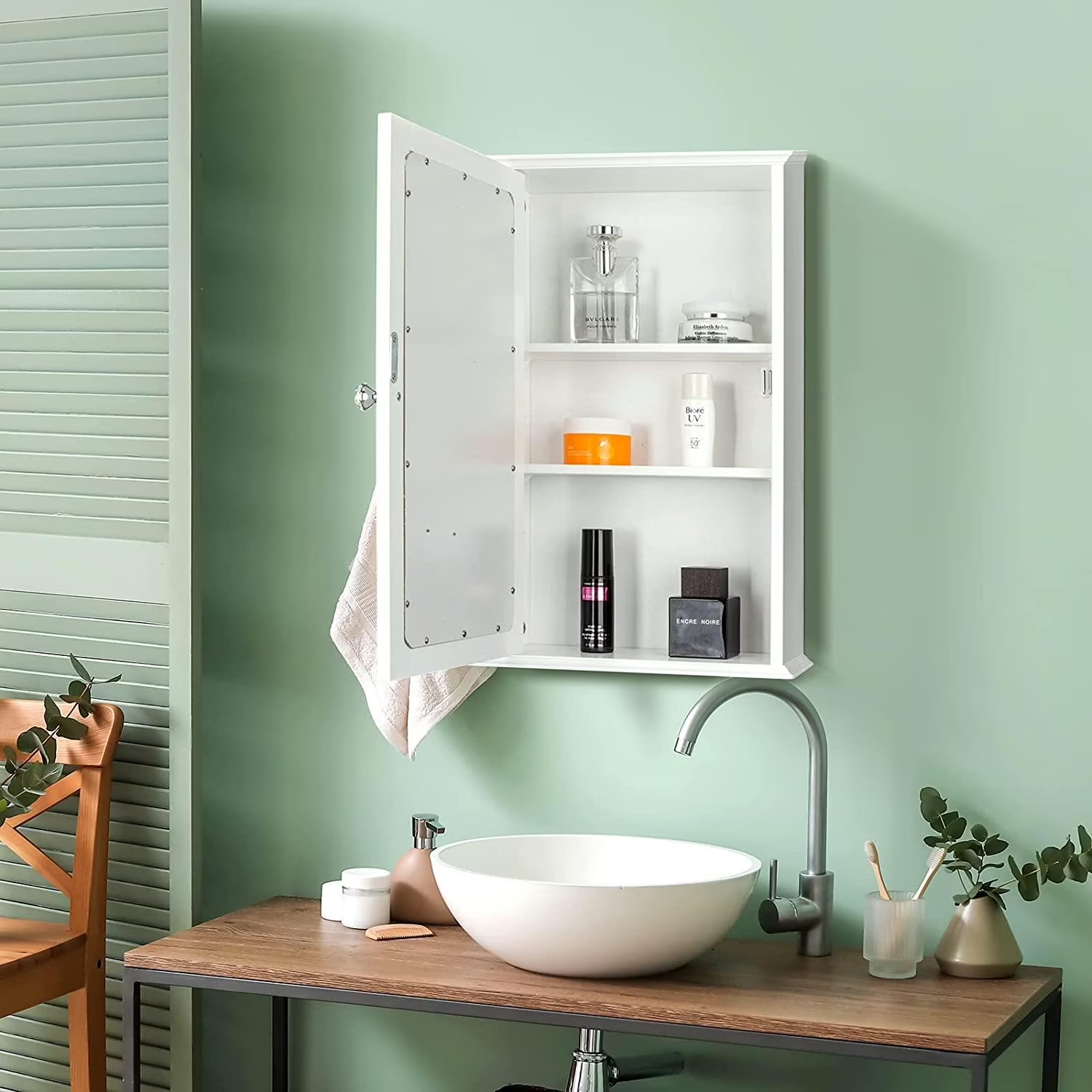
Storage is the problem that bathroom renovation keeps solving in the wrong direction. Most upgrades focus on aesthetics, like new tile, better lighting, updated fixtures, without addressing the functional storage issue at the center of every bathroom day. The average bathroom manages between 25 and 50 products in active use across a counter that runs 21 inches deep and a vanity cabinet that fills with cleaning supplies within weeks of moving in.
The wall above the sink is typically the most underutilized surface in the room. It sits at face height, within arm’s reach of the sink, in front of the most naturally accessed location in the entire bathroom. Installing a medicine cabinet for the bathroom above the vanity is the most direct way to make that wall position work, turning wasted wall space into the highest-utility storage the room can hold.
Purpose-built storage at this position, chosen for the actual inventory it needs to hold, delivers more daily utility per dollar than almost any other bathroom upgrade. The question isn’t whether to include storage here, but which type, size, and configuration serve the specific bathroom and the specific habits it needs to support.
Bathroom clutter has a particular quality. It recurs at the start and end of every single day, in a space where most people are already operating on limited cognitive reserve. The counter-as-default-storage habit, products lined along the back edge of the sink, organized in rough clusters that drift over time, is self-defeating. Products get wet, develop residue rings, knock each other over, and gradually colonize every available surface till the edge of the bathtub.
Moving that inventory off the counter requires storage that’s close enough to use without effort. Under-sink storage works for bulk supplies and products accessed weekly or monthly. Open shelving works for decorative items. But neither addresses the functional core of the problem: daily products, used in front of a mirror, belong at mirror height within arm’s reach of the sink.
Getting the right bathroom wall medicine cabinet installed at this position is the most direct structural solution to the clutter problem. It is also the one least likely to be reversed by the gradual drift that defeats most organizational systems.
The difference between a bathroom that functions well and one that doesn’t is usually a storage position problem rather than a storage quantity problem.
The Vanity Wall Is Your Highest-Value Storage Position
Every bathroom has one high-traffic zone. This is the few feet of wall directly above and beside the vanity. Lighting, reflection, and grooming happen here in close proximity. It is also where people access storage most naturally. You access it at face height, directly in your eyeline while standing at the sink, and you see the contents every time you open the door. You use products stored at this position. You use products stored anywhere else less frequently.
The behavioral research on storage location supports this consistently. Proximity and visibility drive use frequency more reliably than any labeling or organizational system. A product stored at arm’s length in an eye-level cabinet gets used every morning without a conscious decision to reach for it. The same product stored under the sink requires a specific intention to retrieve, which means it gets skipped on rushed mornings and eventually forgotten.
This is why the position above the vanity isn’t just the most convenient storage location but the highest-value one. Whatever goes there will be used. Whatever doesn’t fit there tends not to get used at the same rate. Choosing the right storage fixture for this position is worth more than the total of all other bathroom organization decisions combined.
How the Right Cabinet Changes Daily Routines
Morning routines are partly a friction problem. The easier a product is to reach, the more likely it is to be used correctly and consistently. If it sits behind a door that sticks, under a counter that requires bending, or in a drawer blocked by other drawers, the product is likely to get skipped when time is short. For routines that involve multiple products in a specific order, the physical location of each product determines how reliably the routine gets executed every day.
Choosing the right medicine cabinet for bathroom installation above the vanity addresses this friction at the source. You open the door, find the products at face height in the order you use them, and return them to the same position after each use. The cabinet becomes invisible in daily use. This happens not because it is small, but because it works without requiring any conscious engagement with its organization.
The products that benefit most from this positioning are the ones you use every day in front of a mirror:
- Toothbrush and toothpaste
- Facial cleanser
- Moisturizer
- Contact lens solution
- Prescriptions
- Shaving supplies
Moving these items from the counter into a well-organized wall cabinet frees the counter for the few items that genuinely need to remain visible. In most bathrooms, nothing needs to stay visible.
Layering Storage Types by Access Frequency
A fully functional bathroom storage system uses multiple zones at different access levels for different product categories. The wall cabinet above the vanity handles daily products at immediate reach. The vanity cabinet below the counter handles bulk supplies and backup stock, accessed weekly or monthly. Open shelving handles visible items that benefit from display rather than concealment, such as hand soap, a plant, or a candle.
This three-layer structure solves a problem that single-solution approaches can’t. A very large under-sink cabinet doesn’t solve the problem of daily products at eye level. A very large medicine cabinet doesn’t solve the problem of storing spare supplies in bulk. Using the right storage type at the right position, sized to what actually goes there, produces a bathroom that functions without ongoing reorganization.
Within the medicine cabinet layer itself, the same frequency principle applies. Daily products belong at eye level, accessible without reaching or bending. Weekly products belong on one shelf up or down. Seasonal products like allergy medications, sunscreen, and cold remedies belong at the bottom or in a door pocket. This makes them visible when the door opens but prevents them from occupying prime shelf space.
Sizing, Depth, and Configuration Principles
The most common medicine cabinet sizing mistake is choosing a unit sized to the mirror opening rather than to the storage need. A 24-inch cabinet contains roughly 30% less interior volume than a 36-inch unit. This difference becomes apparent within the first week of actual use. Width should follow the vanity below it. A 36-inch vanity typically works with a 30 to 36-inch cabinet, leaving two to three inches of clearance on each side.
Interior depth determines what actually fits on the shelves. Cabinets under four inches deep force single-file storage. This limits organizational categories and makes back-row items hard to access without removing the front row. Models at five to six inches of interior depth accommodate two rows on most shelves. You can store skincare on one row and medications on the other without any front-row removal required. Adjustable shelving lets you calibrate spacing to the actual product heights you own rather than the heights the manufacturer assumed.
Allsumhome’s medicine cabinet range spans single-door to wide tri-view configurations across multiple widths and interior depths, with integrated LED lighting, built-in 1800W electrical outlets, USB-A and USB-C charging ports, and adjustable shelving on most models. These configurations work around the actual storage geometry of daily bathroom routines rather than assumed defaults.
LED Features Worth Adding to the Specification
The vanity wall above the sink is where most people assess lighting quality every day, which makes the medicine cabinet position the most practical location for integrated illumination. Standard overhead lighting creates shadows at face level; integrated LED lighting at the mirror eliminates those shadows by placing the light source at the same height as the face. For any medicine cabinet for bathroom use that will also serve as a primary grooming mirror, CRI 90+ illumination is the specification that matters.
CRI stands for Color Rendering Index. It measures how accurately a light source renders color relative to natural daylight. At CRI 90 and above, foundation matching, skin tone assessment, and other color-sensitive grooming tasks produce results that hold up in natural light. Models with adjustable color temperature typically range from 3000K warm to 6000K daylight. These add the option of shifting between relaxed ambience and precision task lighting on the same fixture.
Anti-fog functionality, standard on most LED-integrated models, prevents condensation on the mirror glass during and after showers, keeping the mirror usable immediately after bathing. Dimmable touch controls, soft-close hinges, and door-pocket storage accessible when the door is open round out the feature set that makes the difference between a cabinet that functions adequately and one that performs well for years.
The bathroom storage problem is not primarily a space problem, but a position problem. You use products stored at the wrong height, in the wrong type of storage, and at the wrong distance from the mirror less consistently and maintain them less accurately. A well-chosen medicine cabinet for bathroom installation at the vanity position solves that problem structurally rather than organizationally.
No labeling system, bin organizer, or counter arrangement substitutes for having daily products at eye level within arm’s reach of the sink. That’s what this fixture provides. Sized correctly to the vanity, configured for the actual inventory it needs to hold, and specified with the lighting features the position makes possible, it’s the single most functional upgrade available to most bathroom layouts.

